
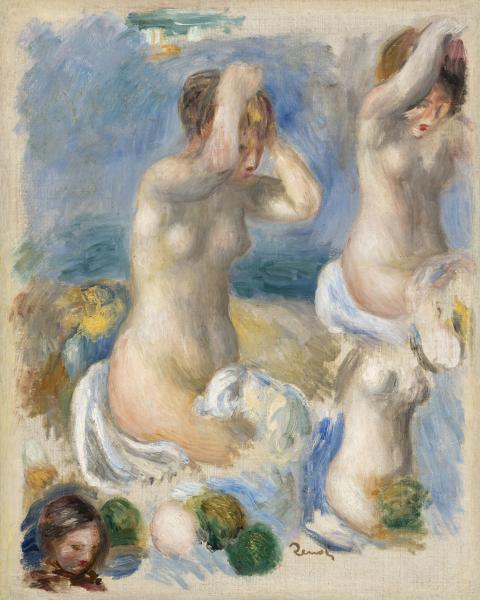
Études de femme nue, 1896
Oil on canvas, signed lower right.
41.30 x 33.20 cm
Provenance :
Ambroise Vollard, Paris, consigned by the artist in 1908
Léon Salavin, Paris (until at least 1954)
Galerie Robert Schmit, Paris
Arthur Tooth & Sons Ltd., London, acquired from the above in October 1973
Sale, Palais des Congrès, Versailles, 1 December 1974, no. 68 (reproduced in colour and on the cover of the sale catalogue)
Baron Hatvany, Budapest
Estate of Baron Hatvany, Hungary
Private collection, Germany, acquired from the above on 27 June 1978
Private collection, Germany, by descent
Sale, Karl & Faber, Munich, 23 June 2022, no. 703
Galerie Ary Jan, Paris
Private collection, Paris
Exhibitions:
• Chefs-d’œuvre de Renoir dans les collections particulières françaises, Galerie Beaux-Arts, Paris, 10–27 June 1954, no. 44 (exhibited under the title Baigneuses).
Literature:
• Ambroise Vollard, Pierre-Auguste Renoir: Paintings, Pastels and Drawings, vol. II, Ambroise Vollard, Paris, 1918.
• Guy-Patrice and Michel Dauberville, Renoir: Catalogue raisonné of Paintings, Pastels, Drawings and Watercolours, vol. 3, 1895–1902, Bernheim-Jeune Editions, Paris, 2010, no. 2089, p. 224.
Certificate of inclusion in the artist’s digital catalogue raisonné issued by the Wildenstein Plattner Institute.
In the second half of the 1890s, the theme of bathers occupies a central place in Renoir’s work. Although it is not a new motif—having accompanied the artist since his Impressionist years—it takes on a different significance at this moment, allowing him to reengage the female nude as a field of pictorial research and experimentation. The absence of any explicit mythological reference or symbolic framework places these figures outside all allegorical registers. The female body is not invested with a meaning external to itself; it appears above all as a subject of formal reflection. The works frequently take the form of autonomous studies, sometimes fragmentary, in which research prevails over formal resolution. From a pictorial standpoint, line plays a secondary role. The body is constructed primarily through color and modeling. Flesh is conceived as a chromatic surface, traversed by multiple tonalities—pinks, ochres, greens, and cool blues in the shadows—which contribute to the structuring of volume. Contours often remain open, deliberately unstable or even blurred, reflecting a desire to privilege pictorial sensation over anatomical definition.
The female body is thus treated as a sensitive landscape, subject to variations of light and matter, rather than as a rigorously delimited form.
Studies of bathers produced during this period, such as the one presented here, cannot always be securely linked to a specific composition. They belong instead to a body of research conducted transversally, nourishing the more developed canvases executed between the late 1890s and the early years of the twentieth century. They bear witness to a decisive moment in Renoir’s evolution, in which the representation of the nude becomes inseparable from a sustained reflection on color, materiality, and perception. Explored over an extended period—like those of other major painters of his time—the theme of bathers provides Renoir with a continuous field of experimentation, through which his investigations are embodied and progressively deepened, ultimately reaching, in the large late compositions, the monumentality and ultimate synthesis of the Baigneuses, often recognized as a true pictorial testament of the artist.